
Architecture guide
Singapore Shophouse Styles: A Guide to the Six Architectural Styles
Everton Estate · 2 October 2026 · 6 min read
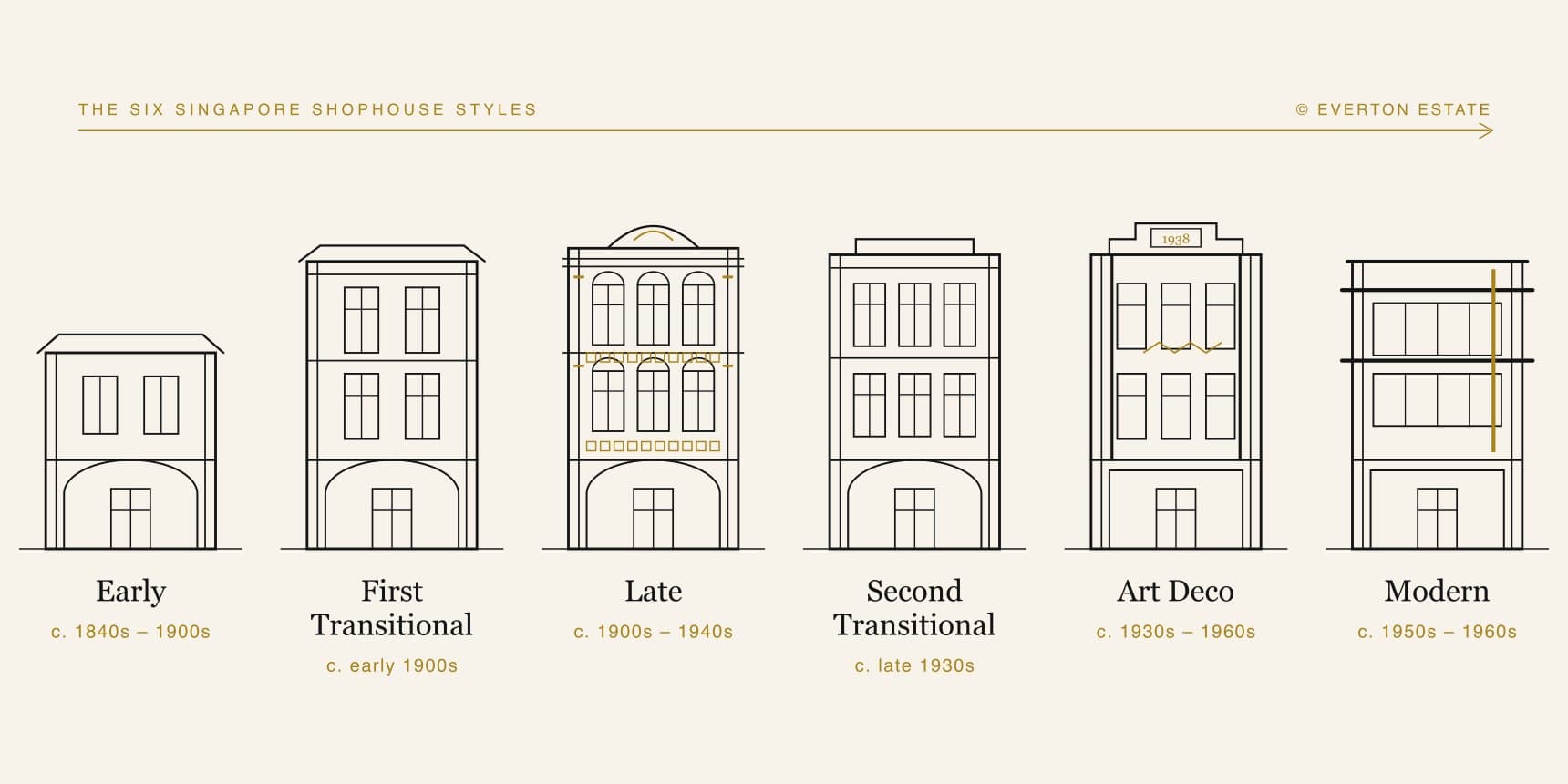
Singapore's shophouses were built over more than a century, from the 1840s to the 1960s, and their facades changed with the times. URA groups them into six architectural styles, shown in the illustration above. Knowing them helps you date a shophouse, understand what must be kept under conservation rules, and see why some facades are worth more than others.
What makes a shophouse a shophouse
A shophouse is a narrow, deep terraced building, usually two or three storeys high, built in a row with shared party walls. Traditionally the family business ran on the ground floor and the family lived above. Whatever the style, most share the same features:
- ◆Five-foot way — the covered walkway along the front, called for in Sir Stamford Raffles' 1822 town plan so that pedestrians were sheltered from sun and rain.
- ◆Airwells and courtyards — open-to-sky spaces that bring light and air into the long, narrow floor plan.
- ◆Timber windows and shutters — tall timber windows with louvred or solid shutters on the upper floors.
- ◆Pintu pagar — the half-height swing doors in front of the main door, letting air in while keeping privacy.
- ◆Pitched roofs of clay tiles, with brick party walls between each unit.
1. Early Shophouse Style (c. 1840s – 1900s)
The earliest shophouses are low and squat, usually two storeys, with one or two timber windows on the upper floor. Builders used locally sourced materials, and plaster decoration is minimal. Look for: plain facades, low proportions and simple windows.
2. First Transitional Style (c. early 1900s)
As Singapore grew wealthier and skilled builders arrived, shophouses became taller — often three storeys — and gained plaster and tile decoration. Small panes of glass began to appear in the timber windows. Look for: taller facades, usually still two windows per floor, and modest ornament.
3. Late Shophouse Style (c. 1900s – 1940s)
The most spectacular style. Facades are covered in plaster mouldings, colourful ceramic tiles and cast-iron details, mixing Chinese, Malay and European motifs. Each upper floor has three windows with very little wall between them, for maximum ventilation. Many of the ornate Peranakan shophouses of Joo Chiat and Katong are in this style.
4. Second Transitional Style (c. late 1930s)
Builders began cutting back on decoration — perhaps a reaction to the exuberance of the Late style, and to the hard economic times of the 1930s. Facades are simpler and more streamlined. Look for: three windows per floor but plain surfaces and simple bands.
5. Art Deco Style (c. 1930s – 1960s)
Art Deco shophouses turn classical features such as columns, arches and pediments into clean geometric shapes. Look for: stepped parapets, strong vertical lines or fins, geometric patterns, and often a panel at the top showing the year of construction or the owner's name.
6. Modern Style (c. 1950s – 1960s)
Built after the Second World War, Modern shophouses are simple and functional. Look for: reinforced concrete, horizontal sunshades or ledges over wide windows, flat roofs or parapets, and almost no ornament.
| Style | Approx. period | How to spot it |
|---|---|---|
| Early | 1840s – 1900s | Low, two storeys, one or two windows, little decoration |
| First Transitional | Early 1900s | Taller, two windows per floor, some plaster and tile |
| Late | 1900s – 1940s | Three windows per floor, rich plaster, tiles and ornament |
| Second Transitional | Late 1930s | Three windows per floor, simpler and streamlined |
| Art Deco | 1930s – 1960s | Geometric shapes, stepped parapets, date panels |
| Modern | 1950s – 1960s | Concrete, horizontal sunshades, wide windows, little ornament |
Why the style matters when you buy
- ◆Conservation rules: URA's principle of maximum retention, sensitive restoration and careful repair means original facade features must be kept or restored. Restoring an ornate Late-style facade can cost more than a plain one.
- ◆Appeal and value: well-kept, characterful facades attract F&B, lifestyle and brand tenants, and often command a premium from buyers.
- ◆Age and condition: the style gives a clue to the building's age. Older shophouses may need more structural work, so budget for a proper building survey.
- ◆Approved use: style does not decide what a shophouse can be used for — zoning and approved use do. Always check them separately.
Sources
- URA — Your Shophouse: Do It Right (2022) ↗
- Roots.gov.sg — The Singapore Shophouses ↗
- URA — Conservation principles ↗
This article is general information based on official sources as at 2 October 2026. It is not legal, tax or financial advice. Rules change — please verify with the relevant authority or a qualified adviser before making a decision.